
The Space Between Two Fingers
On the Hubble Space Telescope, the Pillars of Creation, and a gap on the Sistine ceiling
savcoco - stock.adobe.com
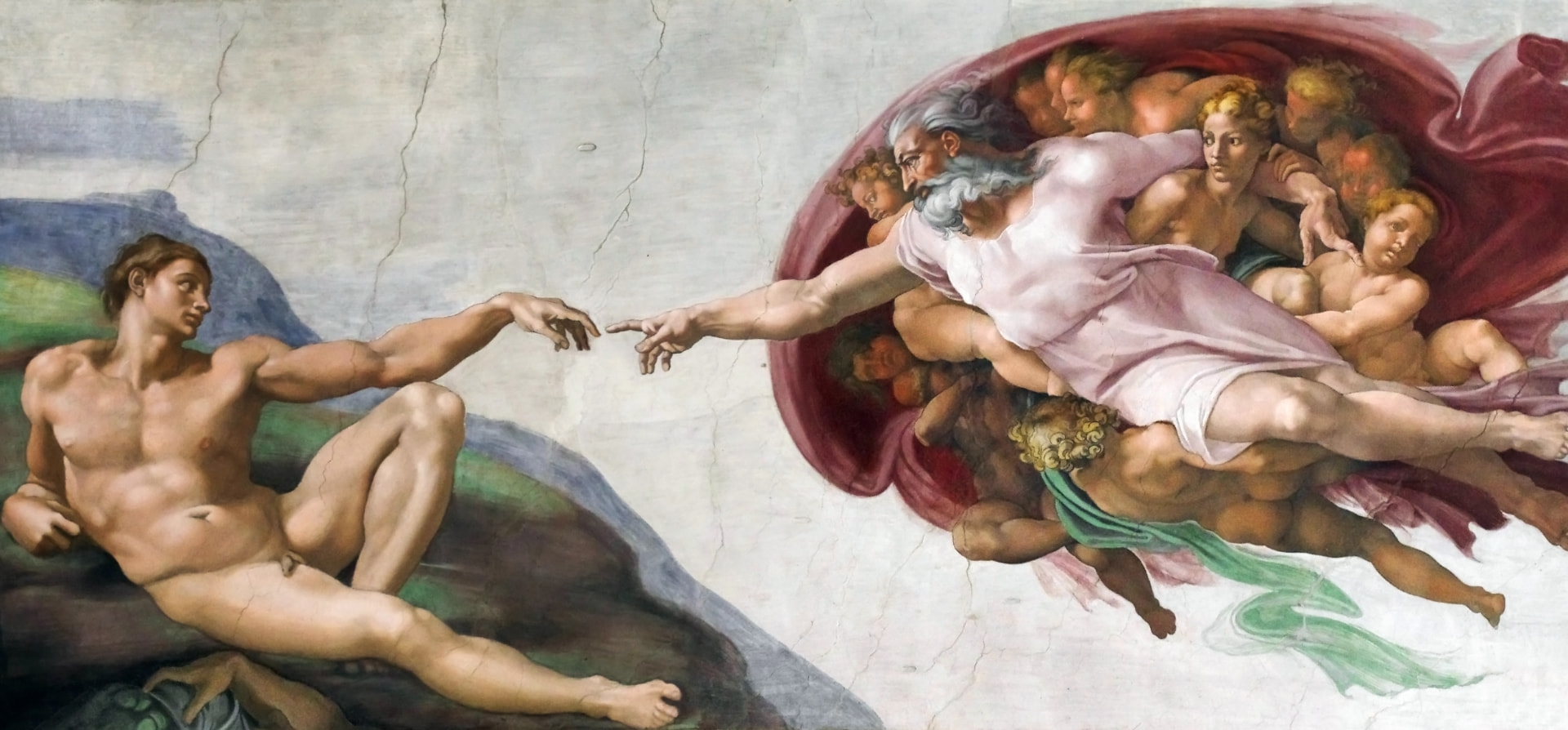
Look closely at the two hands. That is the only instruction Michelangelo leaves us, and most people craning their necks in the Sistine Chapel follow it without being told. On the right, God surges forward out of a swirl of red cloth crowded with figures, his arm rigid, his forefinger straight as a surveyor’s line. On the left, Adam lies back against a bare slope of earth. His arm is lifted but his wrist is slack, and his finger droops, as if he has not quite decided to be alive. The two fingers do not touch. Between them is perhaps an inch of painted sky.
Michelangelo chose to paint the moment before.
Michelangelo chose to paint the moment before. It is the most daring decision on that ceiling, and it is the reason the image has never worn out. A touch would be a beginning. A gap is a question.
I have been closer to that gap than I had any right to be. In the 1980s, when I was NBC’s bureau chief in Rome, the Vatican was in the middle of its long restoration of the Sistine Chapel, and I was allowed up onto the scaffolding. It rose from the chapel floor on a frame that, I was told, anchored into the same sockets in the walls that had held Michelangelo’s own platform nearly five centuries earlier. You climb, and the painting stops being a painting. From the floor the ceiling is a vision. From the scaffold it is a wall, and the wall has a surface, the faint seams where one day’s wet plaster met the next, the strokes pressed into the lime before it set. The restorers were lifting away centuries of candle soot, grime, and earlier attempts at restoration. Colors were coming back that no living person had seen, acid greens and a pale, startled blue.
Years later, on April 24, 1990, I stood at Cape Canaveral and watched the Space Shuttle Discovery carry the Hubble Space Telescope off the pad. Anyone who has watched a launch from the press site knows the order of events. First there is light, a flare so bright it seems to have no source. The shuttle is already climbing. Then the roar arrives, like a message sent from somewhere else. And then, a beat after the sound, something strikes you in the chest. It is the pressure wave, pushing on your body. You do not just hear it. You receive it.
It was a practical lesson in astronomy. Light outruns sound, and sound outruns the body’s slow knowledge of what has happened. The event you see is always ahead of the event you feel. Every astronomer lives inside that delay, only stretched from seconds to millennia. When you look at the brightest star you are seeing a flare that left its source before your great, great grandparents were born. On a clear autumn night, you can see the Andromeda galaxy without a telescope, a faint smudge of light. That light set out two and a half million years ago, when the first of our kind were chipping stone tools in East Africa. It has been traveling for the whole of the human story, and it is only now arriving.
For a long time those two memories lived in separate rooms of my mind, the painted inch in Rome and the push against my chest in Florida. Then, in November 1995, NASA released a photograph, and the two rooms opened into each other.
Hubble had taken it that spring, pointing its Wide Field and Planetary Camera 2 at a region of the Eagle Nebula some 6,500 light-years away. The astronomers Jeff Hester and Paul Scowen were after something technical, the way ultraviolet light from young, hot stars eats away at the clouds around them. What came back was three dark columns of hydrogen and dust rising out of the murk, lit from above, their edges glowing and frayed. The tallest is about four light-years from base to tip. Someone called it the Pillars of Creation, and the name stuck.
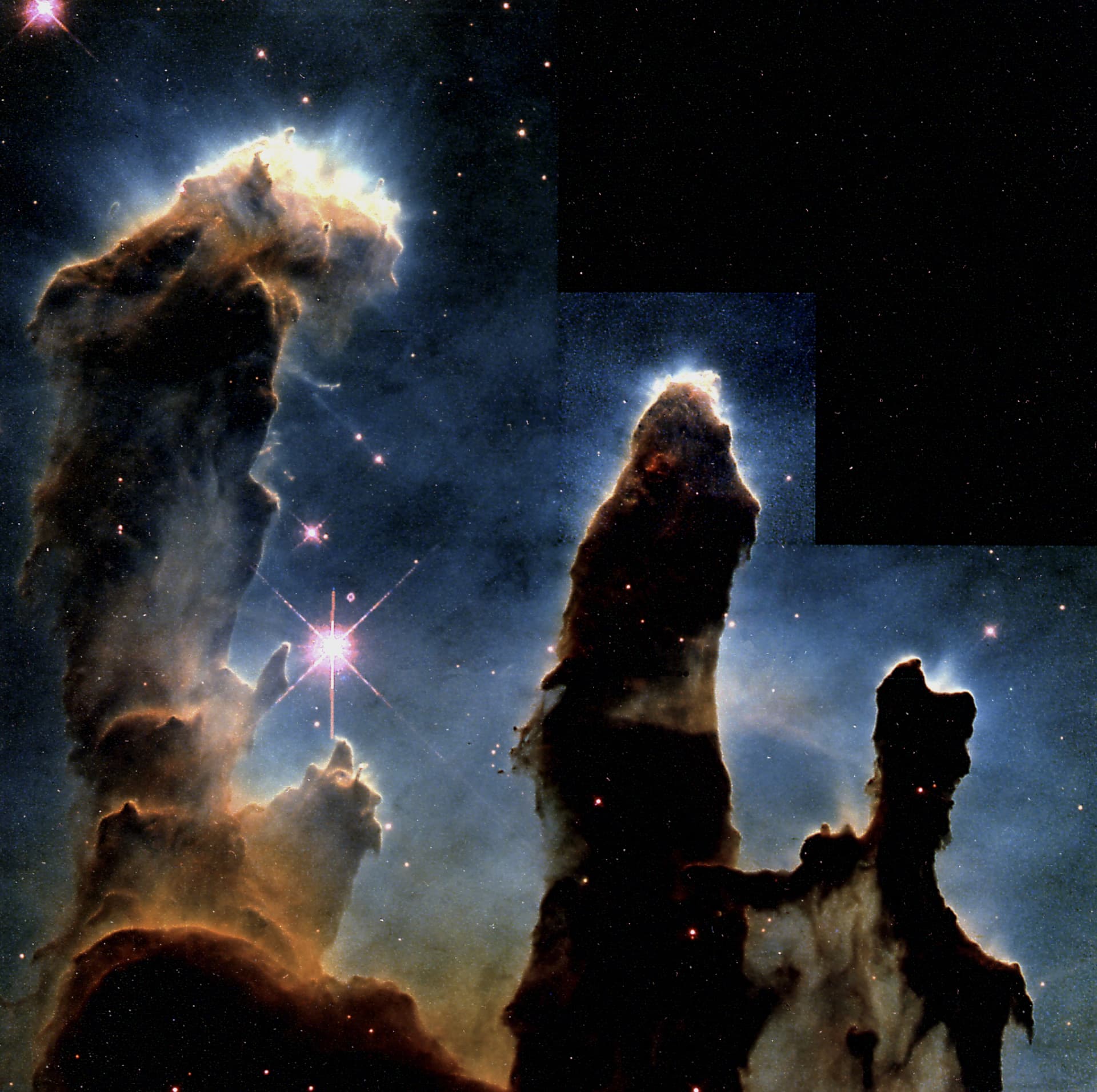
Look at the pillars the way you look at the Sistine ceiling and you notice the same thing. The columns end in small knobbed protrusions, like fingertips, reaching toward the very light that is wearing them away. Inside those tips, where the gas is densest, gravity is pulling matter inward until it grows hot enough to ignite. Stars are being born there. The astronomers gave the dense knots a dry name, evaporating gaseous globules, which they shortened to EGGs. An acronym that says exactly what it means.
In Michelangelo’s panel, creation happens in an instant. God reaches out, and Adam comes to life. In the Eagle Nebula there is no single moment and no hand from outside. Over hundreds of thousands of years, gravity pulls the gas together until it is dense and hot enough to become a star. Meanwhile the light from nearby young stars that carves the pillars is also boiling them away, so the stars forming inside are racing to gather enough material before their nursery disappears. Creation and destruction inhabit the same image.
Yet the two pictures agree on the thing that matters most. Genesis says Adam was formed from the dust of the ground. The astronomer agrees about the dust and quarrels only about the process. The carbon in Adam’s painted fingers and the iron in the blood of every tourist looking up at them were forged inside stars that lived and died before the Sun existed. The Pillars of Creation are not a picture of somewhere else. They are a picture of our own beginning, happening again.
There is a last twist Michelangelo would have enjoyed. Some astronomers, reading infrared data, have argued that a supernova may already have torn the pillars apart thousands of years ago. Others doubt it. If they are right, the light carrying the image is still in transit, a message from something that no longer exists, like the roar that reaches you after the shuttle is gone. We may be looking, once again, at the moment before.
Science is not a monument of finished facts. It is a human act, carried out by people who can be wrong, and Hubble is the proof. It went up flawed. Its primary mirror had been ground to the wrong shape by about two microns, roughly a fiftieth of the width of a human hair, and its first images came back blurred. For three years it was a punchline. Then in December 1993 astronauts flew up with corrective optics, in effect a pair of spectacles, and fitted them in orbit. When the new pictures came down, the effect was what I had seen on the scaffold in Rome: the grime lifted and the colors returned. Both restorations were acts of humility. Both admitted that what we had been looking at was not yet the thing itself.
What Hubble then showed us changed the address we give for ourselves. In December 1995 Robert Williams, director of the Space Telescope Science Institute, spent his own discretionary observing time pointing the telescope for ten days at a patch of sky near the Big Dipper that appeared to be empty, a patch about the size of a pinhead held at arm’s length. It was a gamble. Nobody knew whether anything would be there. The Hubble Deep Field came back with roughly 3,000 galaxies, each holding billions of stars. Nothing in the sky is empty. Hubble went on to help pin down the age of the universe, now put at about 13.8 billion years, and its observations of distant exploding stars fed the discovery, in 1998, that the expansion of the universe is speeding up, driven by something we still call, for lack of understanding, dark energy.
Before Hubble, our place in the universe was a matter of arithmetic that only specialists could feel. After Hubble, anyone could feel it.
The Sistine Chapel was painted for the papal court. Its ceiling belonged originally to a particular place, institution and ritual. Today millions come, but they queue. Hubble’s ceiling was open from the beginning. Its images belonged to the public that paid for them, and NASA and the Space Telescope Science Institute sent them freely into the world. They appeared on newspaper front pages, classroom walls, postage stamps, coffee-table books, computer screens and eventually phones. The Pillars of Creation hung in dormitory rooms beside rock posters. A child in Lagos or London could summon on a screen an image of the Eagle Nebula no astronomer on Earth possessed before Hubble. Few scientific instruments have placed so much wonder in so many hands.
Now the telescope is falling.
Hubble orbits in the thinnest wisps of Earth’s atmosphere, and those wisps drag on it. The last shuttle crew, in 2009, left it at around 565 kilometers. It is now well below 500, and the descent has quickened as the Sun’s recent peak of activity has swollen the upper air. Depending on the Sun, it could come down as early as the end of this decade or as late as 2040. It has no engines of its own. Since 2024 it has been pointing with a single gyroscope, keeping a second in reserve. And at over 25,000 pounds, it is big enough that pieces of its mirror and frame could survive the plunge. It cannot simply be allowed to drop.
So the choice is binary. Someone can go up and raise it, buying years of science. Or someone can go up and fit it with a motor to steer it into a remote stretch of ocean. In 2022 SpaceX and the private astronaut Jared Isaacman offered to study a reboost using a Crew Dragon, at little cost to the government. In 2024 NASA declined, citing the risk of damaging the telescope. Isaacman now runs NASA. The question is back on his desk.
There are newer telescopes, but none simply replaces Hubble. The James Webb Space Telescope can see deeper into the infrared and farther into the early universe, but it does not observe the ultraviolet light in which Hubble remains uniquely powerful. The Nancy Grace Roman Space Telescope, launched in August, carries a 2.4-meter mirror like Hubble’s and will survey enormous areas of the universe with exquisite infrared vision, but it too was built to answer different questions. NASA’s planned Habitable Worlds Observatory is intended eventually to operate across ultraviolet, visible and near-infrared wavelengths, but it is a project for the coming decades, with a possible launch in the 2040s.
If Hubble disappears in the early 2030s, astronomy may lose something that cannot simply be handed to another spacecraft, Hubble’s combination of ultraviolet vision, sharp visible-light imaging and a thirty-six-year record of watching the universe change.
Hubble belongs to that small class of scientific instruments that changed not merely what scientists know but what everyone is able to imagine.
There is also something else, less measurable and perhaps just as important. Hubble belongs to that small class of scientific instruments that changed not merely what scientists know but what everyone is able to imagine. Galileo’s telescope did this. The microscope did it. The first photographs of Earth from space did it. Such instruments alter the scale on which human beings understand themselves.
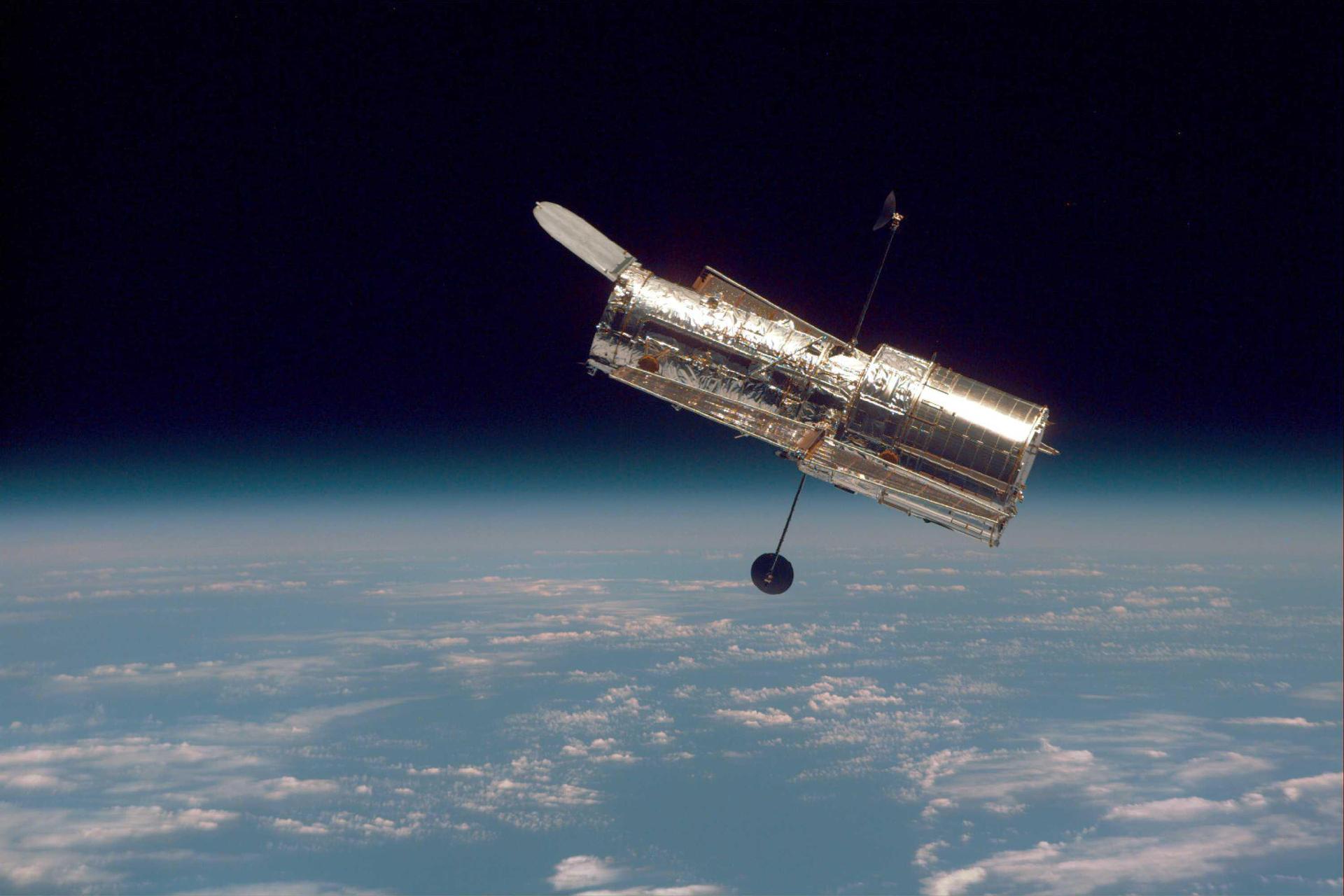
Hubble taught a generation that the universe was not an abstraction. It gave shape to stellar birth and death, showed galaxies colliding, watched stars explode, found black holes where we could not see them, peered so far into the past that infant galaxies appeared as smears of ancient light. It took phenomena that belonged to equations and journals and returned them to the oldest human faculty of all, sight.
And in doing so it changed our place in the universe. Hubble continued our journey outward, from the Earth centric universe Copernicus dismantled in 1543 with the publication of “On the Revolutions of the Celestial Spheres”.
The paradox is that the farther science moves us from the center, the more remarkable our position seems. We are not privileged by location. We are privileged, so far as we know, by awareness. Matter here has acquired the ability to look back across billions of light-years and ask where it came from.
I think about the gap on the ceiling. Michelangelo left it open because the painting is about potential, the instant before life. For thirty-six years Hubble has held a human finger out into that gap, and the universe has reached back. I stood close enough to God’s hand to touch it, and close enough to Hubble’s launch to feel it in my ribs. Both times the lesson was the same. The reaching is the point.
John Steele is the Publisher and Executive Editor of Blue Continuum.
Get The Continuum, our free Thursday newsletter.