Remembering the Future: Blade Runner
More Human Than Human
John Steele is the Publisher and Executive Editor of Blue Continuum.

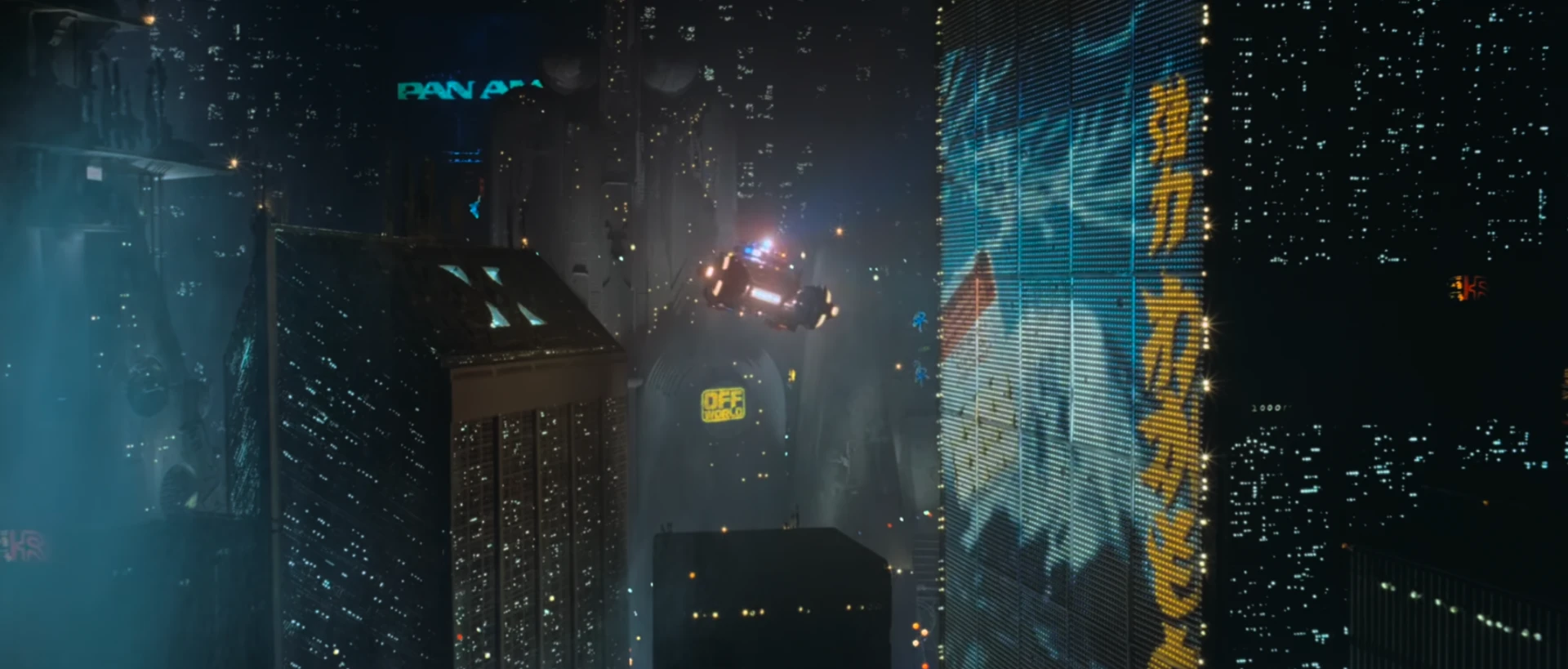
Still from Blade Runner (1982), directed by Ridley Scott.
More Human Than Human
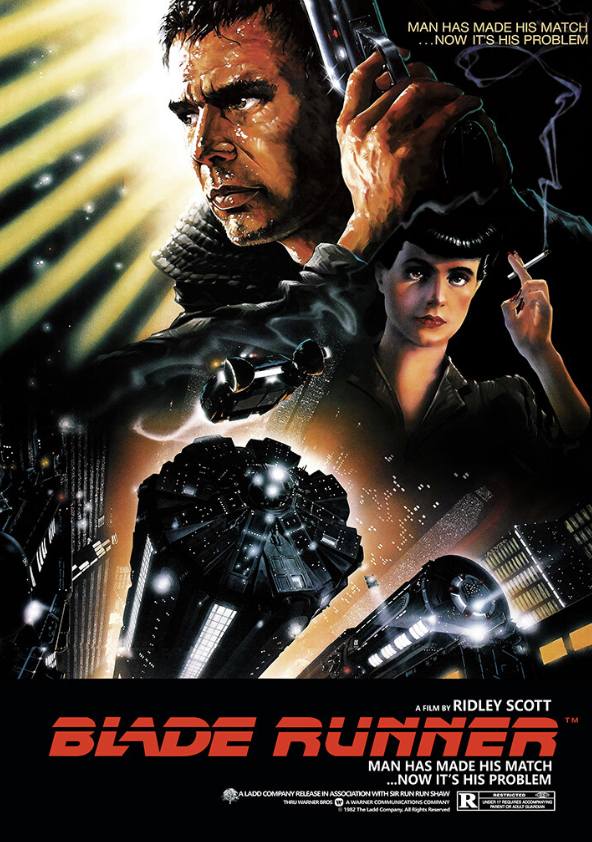
Begin with an image, and not a grand one. Not the towers of some future vision of Los Angeles belching flame into a poisoned sky, not the attack ships off the shoulder of Orion that Roy Batty carries to his death like a private scripture. I want to begin with a man reading a newspaper in the rain.
The streets around him are crowded and layered, thick with languages, the smell of cooking and the noise of a hundred cultures pressed together. Nothing has been made simpler by the future. If anything, everything has thickened. Above it all a blimp drifts between the towers, lights flashing, blaring sound, repeating its promise of departure, of off-world colonies and clean air, The promise of a new beginning somewhere else. The message is relentless, and the man ignores it. His name is Deckard and his work is the policing of a single line. The line between the human and the not-quite-human that the world he lives in has smudged so badly, the instruments built to find it sometimes cannot.
Ridley Scott’s film appeared in 1982 and set its story in 2019. We are now some years past that date and worth pausing over the strange accuracy of what its makers saw. Because Blade Runner, drawn from Philip K. Dick’s restless and visionary novel Do Androids Dream of Electric Sheep?, did not merely guess at technologies. It perceived the human condition those technologies would create, and hold up to us like a mirror.
Between the dense street below and the imagined frontier above move the machines the film calls spinners, personal aircraft that lift vertically and slip between the towers without regard for the old discipline of roads. We are quick to read them as the film’s central prophecy, the flying car at last. But the spinner matters for a different reason. It’s not that it flies. It’s that it flies for some and not for others. It is a police vehicle, an instrument of authority, and the sky it moves through has simply become the newest floor of an old hierarchy.
New power does not by itself dissolve the divisions of the society that wields it. More often it gives those divisions a new dimension to occupy. We are ourselves building what the engineers call urban air mobility, machines to carry us between rooftops in place of streets and the companies that build them speak warmly of democratizing the sky. Blade Runner asks us to watch that promise closely and to ask whose sky it will turn out to be.
The same steady clarity governs the way the film treats life itself. The replicant arrives not as a marvel but as a product, described with the flatness of a catalogue. A synthetic human grown from living tissue, the latest model in a line of design. The opening titles tell us that the Nexus 6 was made stronger and faster than the engineers who made it and at least its equal in intelligence. There is no mystery in the description. The mystery lies entirely in what follows from it.
For the replicant is not a machine in the way a clock, an engine or a robot is a machine. It is an organism. It feels, remembers and reacts. It’s built to resemble us so exactly that the difference cannot be seen but only inferred, drawn out by a test. Here the question changes. It’s no longer whether we can build a thing that imitates life. It’s whether we can make life, and having made it, what we then owe to what we have made.
The instrument devised to find the difference is the Voight-Kampff machine, which reads the dilation of a capillary, the flutter of a pupil, the small involuntary tremor of the iris, in response to questions designed to provoke not thought but feeling. The whole apparatus rests on a single assumption, that empathy is the one thing that cannot be manufactured, the last reliable mark of the genuine article. When the examiner Holden tests the replicant Leon, he describes a tortoise turned onto its back in the desert sun, beating its legs, unable to right itself. The real question beneath the scenario is never spoken aloud. Are you moved by a suffering that is not your own?
Leon answers by shooting him, which is in its terrible way a kind of answer. But the deeper discovery the film is leading us toward is that the line the machine is built to find may not lie where its makers believed. The replicants do not feel too little. They feel too much, and too soon, the whole weight of a human emotional life crowded into four short years. What looks like coldness is only the absence of time, the years a person needs to learn how to carry what they feel. The test built to measure what is missing in them ends by measuring something else, the cost of living without enough time to live.
The corporation that makes these beings states its purpose without embarrassment. “Commerce is our goal here at Tyrell. More human than human is our motto.” It has the ring of an advertising slogan, and yet it carries a claim of the deepest kind. It supposes that the human can be specified and measured and then improved upon. That what we are is not a given but a draft open to revision by its engineers.
To be more human than human is not a promise of imitation. It is a promise of surpassing. The copy has outrun the original. Roy Batty was born in a laboratory and given only four years to live. He has seen things across the darkness of space that no human has seen. Yet he meets his own extinction with a composure that shames the men who hunt him. The Tyrell slogan begins to sound less like corporate vanity than a disturbing possibility. What the replicants lack is not capacity. It is time. And time has been withheld from them out of fear of what they might become.
To soften that cruelty, and to make it manageable, the replicants are given memories. Not scraps, but whole childhoods, manufactured and implanted in such detail that they furnish the illusion of a continuous self. “If we give them the past,” Tyrell explains, “we create a cushion or pillow for their emotions, and consequently we can control them better.” We take our memories to be the very ground we stand on, the proof we carry that we have lived. And yet memory is not a faithful record. It is selective, it shifts, it can be led.
Rachael, who works at Tyrell’s side, does not know she is a replicant. She carries what she believes to be her own past, a mother, a childhood, a spider that lived in a bush outside her window, whose egg hatched one summer and loosed a hundred young that devoured her. When Deckard recites those memories back to her in his apartment, one detail at a time, what comes apart in front of us is not a story. It is a person. The continuity she has leaned her whole self upon gives way, and she is left standing in a life she can no longer be sure is hers.
We like to believe that the self is original, that what we feel, remember and want belongs to us down to the root. Rachael is a thought experiment pressed against that belief until it yields. If a memory can be given, and if the self is built out of memory, then the self is a far more fragile and contingent thing than we care to admit.
This is no longer a difficulty we can hold at arm’s length as fiction. In our own laboratories we have begun to read and to rewrite the language in which a living thing describes itself. The gene-editing tools have crossed in a single decade from the laboratory bench to the clinic. We grow small models of human organs from cultured cells and watch them behave as living tissue behaves. We are learning to author life rather than merely to inherit it. The replicant stands at the far end of that road, and the road is shorter than we like to think. The ascent of our species has never been only the gathering of power. It has been the long, unfinished labor of bringing our wisdom level with our power and here the gap between the two opens wider than it has ever been.
All the while, the off-world colonies hang over the city as the horizon toward which everything leans. They promise room, and light, and release from the weight of the crowd below. The blimp says so: “A new life awaits you in the off-world colonies. The chance to begin again in a golden land of opportunity and adventure.” It is the language of the nineteenth-century emigration pamphlet, familiar in what it promises and familiar in what it quietly omits. For the new worlds are to be built and tended by beings made expressly for the labor. The movement outward does not leave the old arrangements behind. It carries them along intact.
We stand at the beginning of just such a movement ourselves, in earnest and with real resources, toward a permanent human foothold beyond the Earth, and the words we use for it are not far from the blimp’s. A fresh start. A new frontier. A chance to begin again. What Blade Runner understood is that you cannot send humanity to the stars and leave its habits at home. The history of exploration is rarely the simple tale of discovery. It has been bound up with labor and hierarchy and the will to control. The film builds the arrangement into the world it shows us and lets us draw the conclusion.
On the Earth that is left behind, the loss reveals itself in quieter ways. Living animals have grown rare, and when one appears it is very often a fabrication. The owl that presides over the Tyrell reception is beautiful and entirely still. “Must be expensive,” Deckard says, understanding at once that it is not real. “Very,” Rachael answers. The exchange lasts a few seconds and contains a whole vanished world. The natural has become the luxury. What was once given freely now costs more than most can pay, and into the empty place steps a skilled imitation that has learned how to hold its wings. The distinction between the real and the made begins to lose its grip, until we are no longer sure the distinction is doing the work we once trusted it to do.
The replicants bring all of this to a point. They are manufactured, and yet they experience and reach and want. What they want is not dominion. It is duration. More life. When Roy Batty at last comes to Tyrell, having climbed through the defenses of an eight-hundred-floor pyramid to stand before the man who designed him, the scene between them is among the most exact the film possesses. Roy asks for more life. Tyrell answers, with what sounds like genuine sorrow and genuine knowledge, why it cannot be given. The coding sequence cannot be revised once it is set. The altered cells revert. The ship goes down.
“The light that burns twice as bright burns half as long,” Tyrell tells him, “and you have burned so very, very brightly, Roy.” It is offered as consolation and lands as a sentence of death. Roy’s answer is to take his maker’s head in his hands and press his thumbs into the eyes that designed him. He is not a machine throwing a fault. He is a son who has been told by his father that the terms of his existence are fixed and final, and who finds with his whole being that he cannot accept it. The oldest stories we tell are about exactly this, about Prometheus, who did not merely steal fire but forged a new and unpaid debt between the maker and the made and suffered for it. Tyrell has stolen something more intimate than fire. He has stolen the inner life, and the reckoning, when it comes is one no maker can settle.
The last movement of the film belongs to Roy alone. He hunts Deckard through the emptied floors of Sebastian’s building, not only to kill him but to make him know what it is to be hunted, to live in fear of a thing stronger and swifter than yourself. “Quite an experience to live in fear, isn’t it?” he says, with Deckard cornered on a rooftop in the rain. “That’s what it is to be a slave.”
And then, having said it, he saves him. Deckard’s grip fails on the wet ledge and Roy’s hand shoots out and catches him by the wrist, hauling him up over the edge with that strength that was engineered for other purposes and is here turned toward something no engineer put into him. He sets the man down on the roof and sits beside him, and we can see the four years running out of him at last.
I’ve seen things you people wouldn’t believe. Attack ships on fire off the shoulder of Orion. I watched C-beams glitter in the darkness at Tannhauser Gate. All those moments will be lost in time, like tears in rain. Time to die.
Roy is not protesting his death as an injustice. He is bearing witness in the last clear minutes he has to the plain fact of impermanence, to the knowledge that what has been seen and felt and loved does not endure merely because it was vivid. He has seen extraordinary things and they will go out with him, as everything goes out in the end, as the stars themselves will one day go dark. The difference is that he knows it and meets it without turning his face away. The white dove he has been holding lifts into the wet air as he stills. Something is being given up and something released.
Blade Runner was never an exercise in forecasting. It was a meditation on what becomes of us when the boundaries begin to dissolve, between human and machine, between memory and reality, between the maker and the things made. We are moving now into a century in which life may be engineered, intelligence manufactured, and consciousness perhaps no longer the sole possession of the born. The question the film presses into our hands is no longer a question of science fiction.
So, we are returned to the question that has run beneath the film from its first frame. It is a question about us. What will it mean for us and what we take ourselves to be when we can manufacture life, and perhaps one day the inner light of consciousness itself? When the thing we have made opens its eyes and looks back at us with a need we cannot help but recognize as our own. To make such a being is to incur a debt to it. That is the consequence the film insists we see and the one we are least practiced at seeing. We are about to become makers of that kind. What it will mean for us depends on a single thing, whether we come to that threshold with our wonder and our conscience intact or cross it as Tyrell crossed it, proud of the brightness of the flame and indifferent to how briefly and at whose cost it was made to burn.