Time, Layers, and Climate Futures
A conversation with Dr. Gavin A. Schmidt on paleoclimate, resilience, and the fragile blue world we are choosing to build.

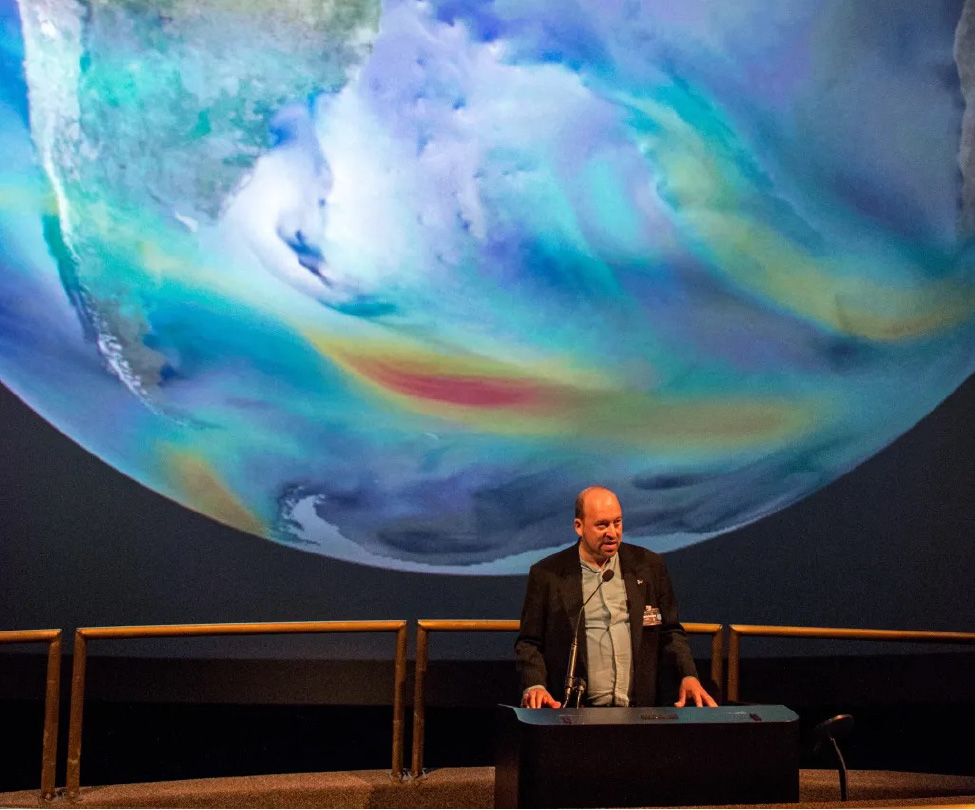
Time moves through the Earth in layers. Ecological, cultural, and climatic histories remain embedded in the present, shaping both the world we inhabit and the future now taking form. Few scientists work across these immense scales of time as directly as Dr. Gavin A. Schmidt, Director of NASA's Goddard Institute for Space Studies.
Schmidt's research connects the deep past with the unfolding future. Drawing on paleoclimate records, instrumental observations, and sophisticated Earth system models, he studies how natural climate variability and external forces, including rising greenhouse gas emissions, interact to alter the planet's trajectory. His work also confronts one of science's most consequential challenges: translating the complexity of the climate system into projections that can guide decisions in the present.
In this conversation, Schmidt explores how natural and human-driven climate change affects biodiversity and the living systems upon which we depend. He considers what ice cores, tree rings, coral skeletons, and other records of ancient climates can tell us about the risks ahead and about the possibilities for building a more resilient future.
The future, Schmidt reminds us, is not fixed. It is being shaped by choices made within the noisy, dangerous and uncertain present. The climate system is vast and intricate, but it is also profoundly responsive to human action. The evidence preserved in ice, coral, sediment, and soil offers both warning and guidance. To heed it is to act not only for our own survival, but for the living systems, human cultures, and fragile blue world that make life possible.
Noise, Signal, and the Shape of the Future
My first question is about Earth's climate variability and human futures. Your work focuses on both natural internal climate variability and the climate system's complex response to external forcings. How do these dual forces shape the reliability of our future climate projections, and what do you see as the greatest scientific challenge in narrowing uncertainties?
When we look at satellite data we see a very complex set of things. If you look at a satellite map of clouds or of dust storms, everything is very intermingled. Everything is very chaotic and noisy, and it is chaotic in a very strict mathematical sense of the word. Yet we know that if you push the system through changes in the earth's orbit, or big volcanic eruptions, or the sun waxing and waning as it goes through its 11-year cycle, we can see clear changes even though it's a very, very noisy system.
When you're looking at the system, you have to always have both of those things in mind: that there is a lot of internal variability related to weather patterns, El Niño, or things going on in the North Pacific. These occur in unpredictable ways, and we can assess how unpredictable that is. The weather itself is not really predictable beyond about 10 to 14 days from a very fundamental standpoint. One can think of that chaotic component as noise hiding a signal that might be deeper in, a signal you can sometimes average your way toward, something changing in the boundary conditions, in greenhouse gases, in the land surface, in volcanoes or the orbit of the earth.
You have to look at the difference between predictions and the real world carefully because the real world has that climate signal, but it also has random noise. Our models produce coherent noise of their own alongside the climate patterns. If we don't take that into account we can fool ourselves into thinking things are happening much faster or much slower than they are.
You might remember a decade or so ago, when some folks were very concerned that Arctic sea ice was going to disappear imminently. That was based on one or two outlier points, which, if you put a line through them, would say, oh my gosh, everything is falling apart. Wiser voices cautioned that not everything is climate; some of it is just weather. And those people, who included me, were correct. The ice didn't disappear the next year.
We can never have a purely deterministic climate prediction that the temperature in July 2050 will be exactly this temperature. But it's mostly not a problem, because the signals from increasing greenhouse gases, from aerosols, from ozone, are large. The big uncertainty for those future projections is what we decide to do. What are we as a society going to emit? How much deforestation are we going to allow? Those have a bigger impact on temperatures in 2050 than worrying about whether there's going to be an El Niño or a La Niña.
How do aerosols and air quality factor into the climate system and public health?
There are lots of natural aerosols, dust in the air, haze from forests, sea salt from the ocean. But we've changed the aerosol composition by putting in lots of criteria air pollutants: nitrate, sulfates, from internal combustion engines, from burning dirty coal, some agricultural practices, and industry. Those have changed the composition of the atmosphere, particularly in the post-war period, peaking around the late 1970s and early 1980s, and we've been cleaning up our air ever since.
There are a lot of things that are not independent of one another: climate, air quality, public health, ecosystems. They interact and also have direct consequences. In cities where aerosols are very high, premature mortality can reach into the hundreds of thousands of people per year. It's really nasty stuff.
Reading the Paleoclimate Record
What can paleoclimate records, ice cores, tree rings, coral skeletons, teach us about resilience in the face of climate change, and how should these lessons inform current policy and adaptation strategies?
There's a lot to be learned from the past. You mentioned a few of the proxy archives: ice cores, tree rings, and ocean sediments, which give us records going back maybe a hundred million years. Then we have the rock record on land. Through these sources, we can trace major extinction events in the paleoclimate record. We've assembled both temperature and carbon dioxide records covering the last 500 million years, and these clearly show connections between what happens in the atmosphere, the climate, and ecosystems.
We use this paleoclimate record to test and refine our understanding, testing how well climate models match what happened during past warm periods like the Pliocene, three million years ago, or the Eocene, some 50 million years ago. These are tough tests, and earlier models didn't perform very well, but newer models are doing better. This helps us calibrate how much warming to expect in the future. Paleoclimate data help constrain concepts like equilibrium climate sensitivity, basically, how much the planet warms when carbon dioxide levels double.
It's not just about testing models. The paleoclimate record also tells us about resilience, how ecosystems and species responded to change. Plants and animals shift with climate: they follow water and temperature, retreat from rising seas, and expand during lower sea levels. We have detailed information about how rainforests became savannas during dry periods and then recovered, showing both resilience and limits of tolerance.
This isn't precise enough to say "everything is fine until 1.67 °C above pre-industrial and then it all collapses." It does give us a sense of where tipping points might lie, for corals, fisheries, forests, how cold or warm conditions affect their viability, and how long recovery might take.
Many experts say we're already in the midst of an extinction crisis. What lessons can we draw from the past that should inform current policies and strategies?
The biggest thing that we need to learn is that things are not always as they are, that things change, and things can change quite quickly. We have a heuristic bias in thinking that whatever is around us right now has always been there and will always stay there. That's not what history tells us.
When people talk about the extinction crisis, they think, oh, it's just an obscure insect here, or maybe a rare bird. But when you go back into the past and see when the whole system has been stressed to a breaking point, you get mass extinction events. The most famous is the asteroid at the end of the Cretaceous, but the other extinction events were internally driven. You end up with situations where the carbon cycle goes crazy, the land surface goes crazy, and you lose something like 80% of all species.
Our particular moment has an extinction crisis driven by multiple stresses on the environment. Climate is one of them, but also habitat loss, biomass destruction, and the disconnectedness of preserves and wilderness, animals can't just migrate continuously toward more appropriate climate regimes, they're blocked. Habitat loss, climate change, poaching, they combine to threaten not just individual species but whole ecosystems.
Translating Complexity
Earth system models incorporate vast and complex data sets. What are the most effective ways to translate this complexity into public understanding without oversimplifying, and how important is this translation to inspiring climate action?
This is absolutely fundamental. These system models have grown over the years. They've accumulated more and more complexity, even the people running them are not totally aware of everything that's in them, a million lines of code plus. It turns out that you need to include that to be able to get the things that people care about, how the weather is going to change by the time we get to 2030, 2050.
Most of the work that is done with these models is not really a public friendly environment, but the impacts of climate change, what we need to protect against, what we need to adapt to, what we need to avoid, all of those things can be extracted in ways that are much more salient to people's lives and needs.
What an apple farmer in upstate New York is sensitive to is very different from a corn grower in Iowa, which is very different from a subsistence farmer in the Amazon, which is very different from somebody growing taro or cassava in Africa. All of those people need to know about what the climate is going to be like. We haven't yet found a universal language that allows for these people to get exactly what they need. That's a failure on the scientific and governmental side.
Ten years ago, you might've got away with saying, "there's climate change, we can see it in the global mean, we can see it in the Arctic, but it's not really affecting me where I live." That attitude has evaporated. People are seeing changes: wildfire, intense rainfall, coastal flooding, heat waves. The need to know has become much more salient. The questions people are asking are much more specific, and we as a scientific community have not yet risen to that challenge.
People restoring landscapes want precise guidance on what species to plant. How hot is it going to get here, and how quickly? What climate are they actually planting or restoring for?
Exactly, yes. Those are absolutely vital questions.
You've written about how skill in representing past climate change can help constrain projections. Which past climate events do you think hold the most relevant clues for the conditions humanity might be facing in the coming century?
It's a whole range of things. You can go back five, six, or seven thousand years, when the Sahara was much greener. Why was that? How can these systems flip? Is that relevant for savanna areas now facing desertification? That's very interesting.
If you look back to the cold periods, the Last Glacial Maximum, around 20,000 years ago, that helps us constrain how much warmer it could get in the future. Then you can go back to the Pliocene, about three million years ago, a world with very little ice. Greenland completely melted, West Antarctica melted or never fully formed. The sea level was about 25 meters higher. It's not a perfect analog, but it's a useful comparison for what we might see under a "burn-it-all" scenario.
Going back even further, the Miocene and Eocene tell us what the planet was like at much warmer temperatures and much higher sea levels. We learn a lot by looking at these extremes. Even though we hope our climate won't shift nearly as far in either direction, they help us understand the trajectory and underlying tendencies.
Choice and the Unfixed Future
Would you comment on how the misallocation of resources in climate mitigation and adaptation could change the outcome for us?
The outcome is very much still to be determined. What happens depends on what we do. We're not locked into some terrible trajectory. The climate change we'll experience going forward is largely a function of what we're putting into the atmosphere today, tomorrow, and in the years ahead. If we decide to stop doing that, then it won't keep getting warmer. Sea levels will still rise somewhat, but we can collectively decide to stop global warming. One hopes that, eventually, we will make that choice.
What gives you hope as you look toward the future? What do you feel is most urgent for us to address right now?
The urgent need right now is to reduce emissions. That means phasing out internal combustion engines, ending the burning of coal and natural gas, and stopping deforestation. If we focused on those things, we'd address about 80% of the problem.
Is there any other information you think the public should know, or questions we should be asking, that we're not?
There are other things we can do at an individual level that I think are important. Talking about this, sharing your concerns and values with other people, is incredibly powerful. You often discover that what you thought were your private worries are actually shared by many. We sometimes feel isolated because of the noise in the media or on social platforms, but those spaces don't really reflect what most people think. We should be more vocal, more engaged, and not afraid to talk about these issues.
There are practical choices in our daily lives that both help and send signals to others. For example, we have an e-bike that we use to get around, so we don't need a car anymore. We've encouraged friends to do the same, and some of them have gotten rid of their cars too. Advocating for safer biking in cities and more walkable spaces is another way to help reduce reliance on cars, not by banning what people need, but by creating better options with a smaller footprint.
You can also choose to buy power from renewable energy companies, which sends a clear market signal to investors about where support should go, toward clean energy rather than dirty power.
Beyond personal choices, we can have outsized impacts by speaking up: writing letters, showing up at town halls, PTA meetings, or public events, joining demonstrations, or participating in things like Climate Week in New York. All of these actions send the message that your voice and your concerns matter. Ultimately, that's what drives change.
Gavin A. Schmidt is a British climatologist, climate modeler, and Director of the NASA Goddard Institute for Space Studies (GISS) in New York.
Gayil Nalls is the Co-Founder & Senior Editor of Blue Continuum and President of the World Sensorium Conservancy.
This interview previously appeared in Plantings.