If a Lion Could Speak.
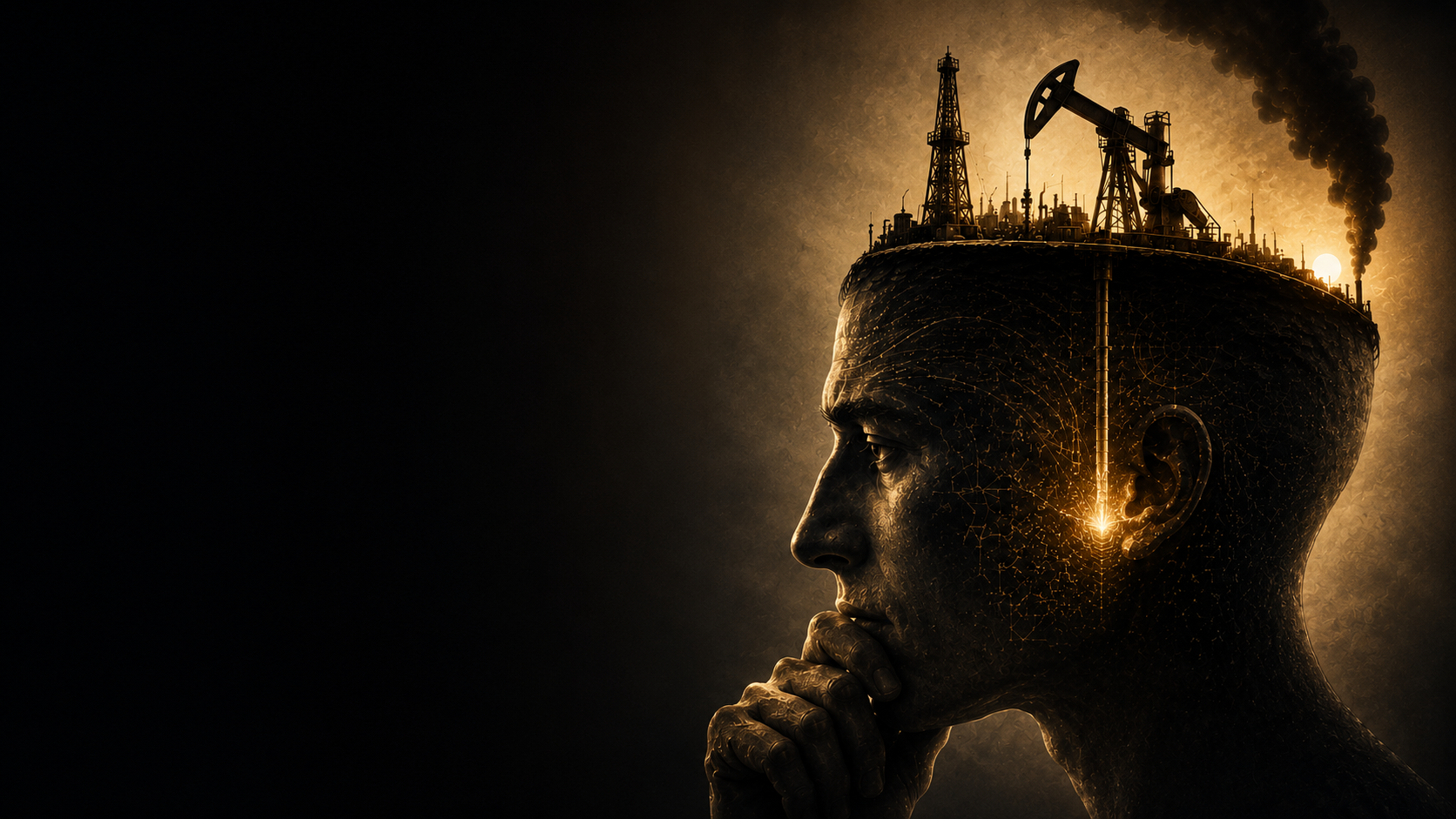
Wittgenstein believed that if a lion could speak, we could not understand him. The sperm whale may be teaching us to revisit that doubt.
Lead image by Matt Porteous
There is a sentence by Ludwig Wittgenstein that has survived for nearly a century because it touches a mystery deeper than language.
"If a lion could speak, we could not understand him."
At first, the statement seems paradoxical. If the lion spoke English, surely we would understand the words. We could consult a dictionary. We could parse the grammar. We could transcribe the sounds. Yet Wittgenstein understood that language is not merely a collection of words. It is an expression of life.
The lion's difficulty is not that he lacks vocabulary. It is that he inhabits a world we do not.
For much of human history we have assumed that the reality we experience is reality itself. We open our eyes and a world appears. We hear sounds, see colors, feel warmth and cold, and imagine that we are encountering the universe directly. Yet one of the great revelations of science is that what we call reality is only a narrow selection from a much larger whole.
The visible spectrum, the rainbow of colors that fills our world, occupies only a tiny fraction of the electromagnetic spectrum. Beyond it lie ultraviolet light, infrared radiation, X-rays, gamma rays, and radio waves. They surround us continuously, passing through our bodies and through the walls around us, unnoticed except by the instruments we have built to detect them.
The same is true of sound. Human hearing occupies a narrow range of frequencies. Beneath it are the infrasonic vibrations used by elephants and generated by storms. Above it are the ultrasonic worlds of bats and insects. The universe is alive with signals we neither hear nor see.
What we experience as reality is therefore not reality in its entirety. It is reality filtered through the particular senses of a primate that evolved on the African savannah.
The biologist Jakob von Uexküll gave this insight a name: Umwelt, the surrounding world as experienced by a particular organism. Every creature inhabits its own sensory universe.
A bee sees ultraviolet patterns hidden within flowers. A pit viper perceives heat. A bat constructs a world from echoes. A dog lives in a landscape of scent whose richness we can scarcely imagine. Each species occupies the same physical universe, yet each experiences a different reality.
The difference is not merely one of interpretation. It is one of perception.
A bat does not disagree with us about the shape of the world. It encounters a world assembled from information unavailable to us. The bee does not hold a different opinion about a flower. It sees structures we cannot see. Its reality contains dimensions absent from ours.
This realization transforms Wittgenstein's lion.
The challenge is no longer one of translation. It becomes a question of access. Could we understand a creature whose experience of the world differs fundamentally from our own?
"If Wittgenstein was alive now, I think he would want to revisit that question."
When I put Wittgenstein's observation to marine biologist David Gruber, CEO and founder of Project CETI, the Cetacean Translation Initiative, he answered thoughtfully.
"I admire all the philosophers for really pondering these deep questions," he told me. "That's one of the things that makes us human."
Then he added a qualification Wittgenstein himself might have appreciated.
"If I was in Wittgenstein's time, I would very much agree. But if Wittgenstein was alive now and saw some of the tools that are available, and some of the progress being made in the more-than-human space, I think he would want to revisit that question."
Science rarely abolishes great questions. More often, it changes the distance from which we view them. The sperm whale is an unlikely guide to this possibility.
Humans and whales share a common ancestor that lived approximately ninety-two million years ago. Since then, our evolutionary paths have diverged dramatically. One lineage remained on land and eventually produced primates and human beings. The other returned to the sea.
Over millions of years whales transformed themselves into creatures perfectly adapted to an aquatic existence. Their limbs became flippers. Their nostrils migrated to the tops of their heads. Their bodies grew immense. Most remarkably, they developed a sensory relationship with sound unlike anything humans possess.
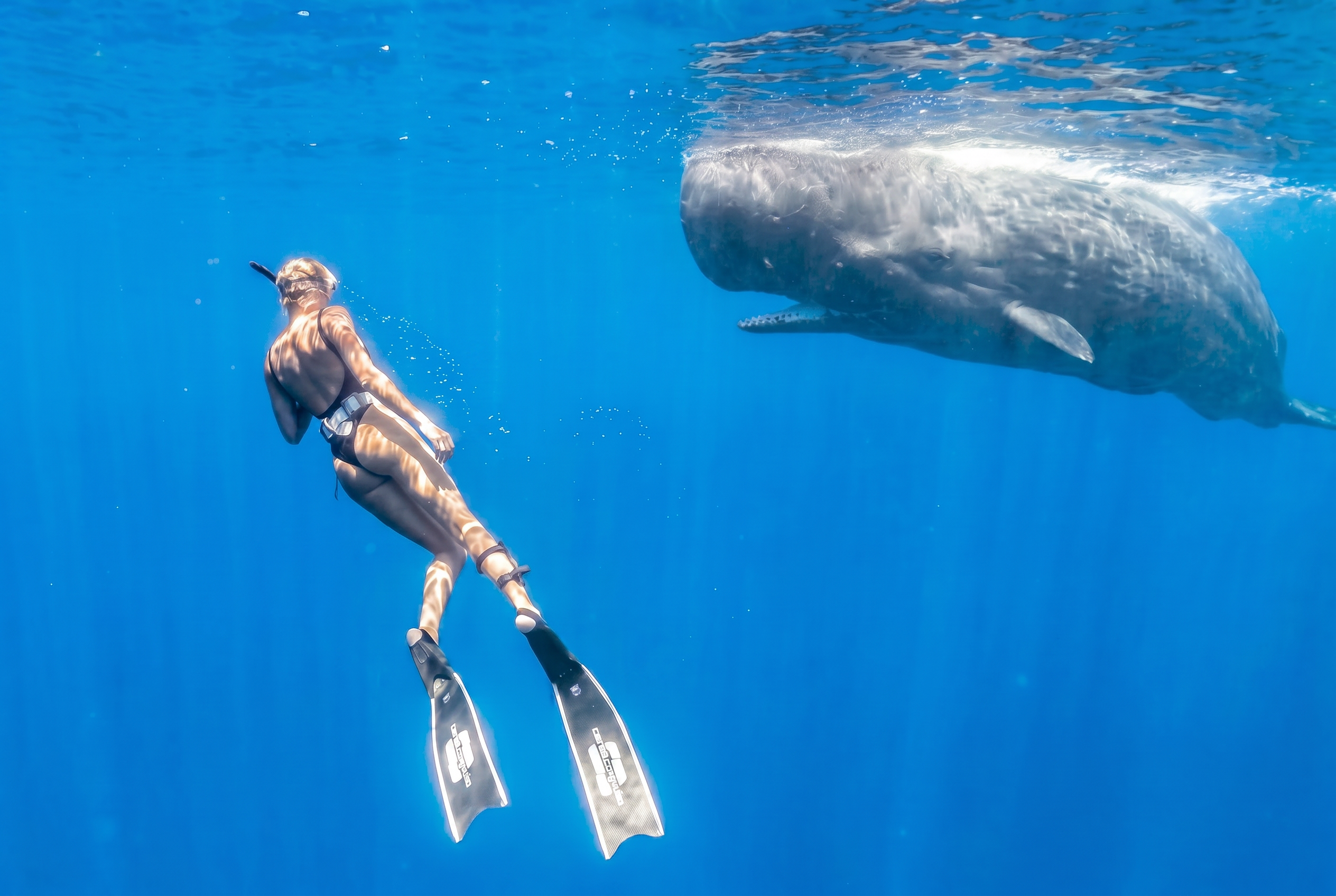
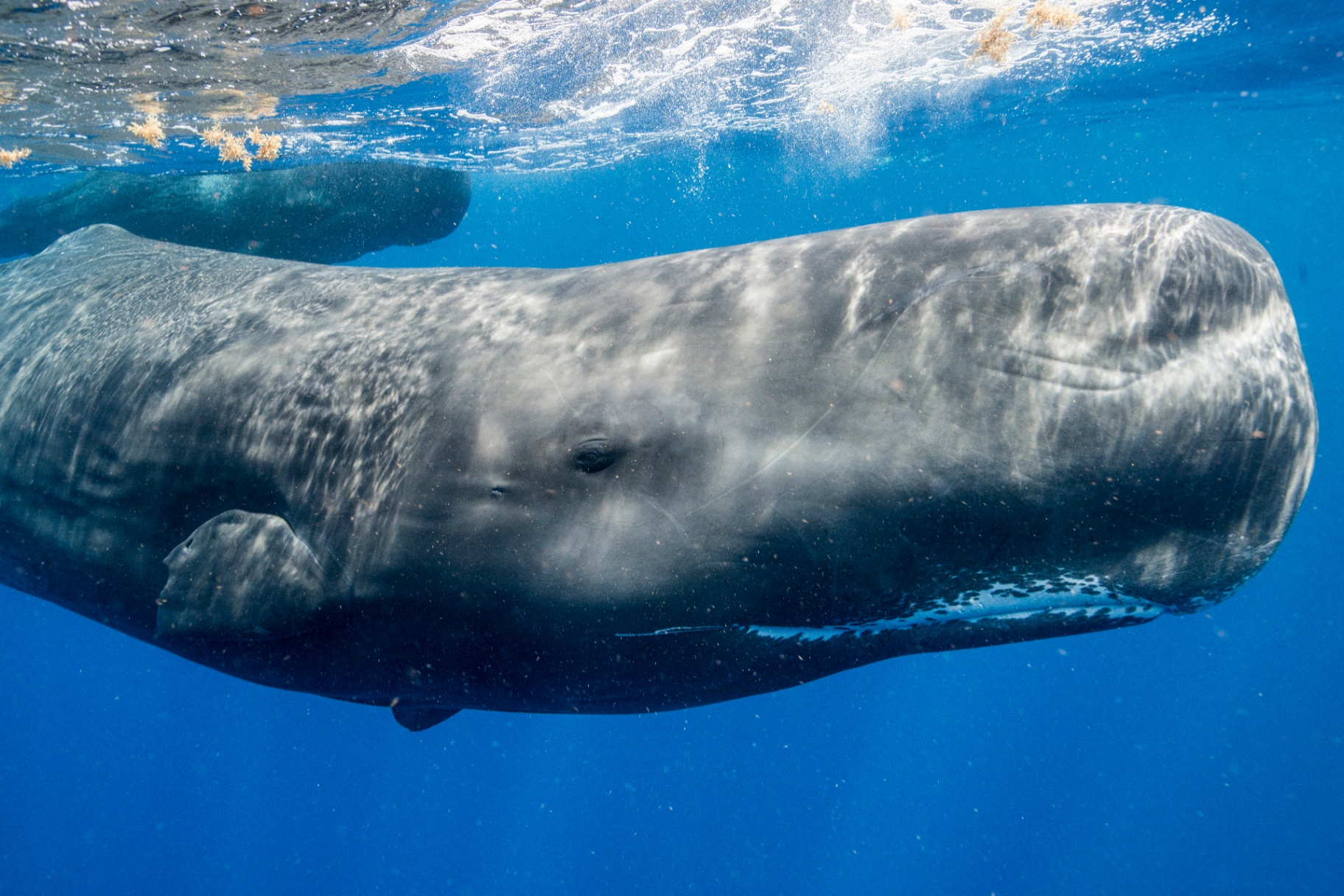
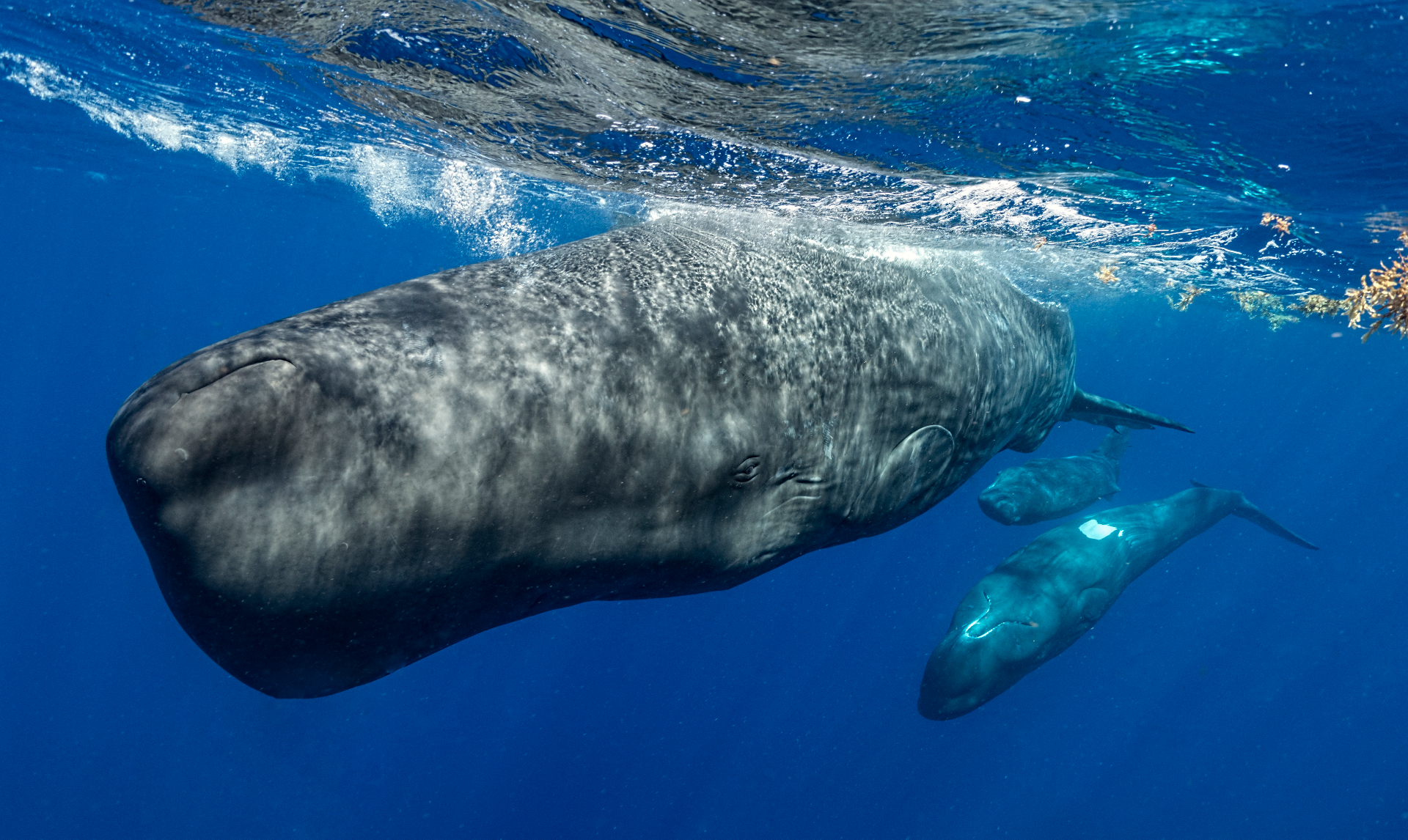
A sperm whale spends much of its life in darkness. It descends thousands of feet beneath the ocean's surface, often nearly a mile deep, where sunlight never reaches. There, vision becomes almost useless. Sound becomes everything.
"They're spending about seventy percent of their vocalizations in deep dark water with no light," Gruber explained. "They have this ability to send out very loud clicks into the deep dark ocean and then process the echoes almost like an acoustic image."
An acoustic image. Human beings construct reality primarily through light. We are creatures of vision. We navigate by horizons, faces, gestures, colors, and stars. The whale inhabits another sensory order. It sends a pulse into darkness. The darkness answers.
The returning echoes carry information about shape, distance, texture, movement, perhaps even identity. From those echoes the whale constructs an understanding of the world around it. Its world is not illuminated. It is resonant. To understand such a creature, translation alone may not be enough.
When I asked Gruber whether CETI was trying to translate whale communication or reconstruct a whale's sensory reality, he answered simply: "Yes and yes."
Translation without context tells us very little. To understand what a whale says, we may first have to understand what it is like to inhabit a world where darkness is ordinary, where sound paints landscapes, and where family members spend decades diving together through an ocean of echoes.
Listening to Gruber describe the challenge, one is struck by how often it requires acts of disciplined imagination.
"It forces me as a human to be like, all right, what would it be like to be this animal?" he said. "What would it be like to be this animal that doesn't have arms, that's living in the dark, that has this ability to shoot out sounds and hear the echoes?"
Science begins with observation. It also requires empathy. The willingness to imagine that another creature's experience may be as rich and coherent as our own.
For centuries we listened to whale sounds and heard noise. Then we heard songs. Now we are beginning to hear structure.
For decades scientists recognized recurring patterns in sperm whale clicks known as codas. Certain clans possess distinctive vocal traditions. Young whales learn these traditions from older members of their families. Different populations exhibit different dialects.
The existence of culture in whales was already remarkable. What has emerged more recently is the possibility of greater complexity still. Gruber's team has identified structures embedded within whale vocalizations that had previously gone unnoticed. Some resemble what linguists describe as vowel-like features. Others involve subtle changes in timing and rhythm that human listeners often fail to detect but computational analysis reveals consistently.
The discovery does not mean whales are speaking a version of human language. It means something more interesting. Communication systems separated by ninety million years of evolution may nevertheless arrive at similar solutions to similar problems.
Biologists have long recognized that evolution often invents the same idea more than once. Wings evolved independently in insects, birds, and bats. Eyes emerged multiple times throughout the history of life. Similar environmental pressures often produce similar innovations.
Perhaps communication follows a similar path. Gruber sees the discovery in precisely those terms. "We're beginning to see similar features had independently evolved in the whale world," he told me.
The history of science is filled with moments like this. Galileo turned a telescope toward Jupiter and suddenly the heavens were no longer what they had seemed. Darwin looked at finches and fossils and saw evolution where others had seen isolated facts. The universe itself had not changed. Human perception had.
Whether that structure ultimately qualifies as language remains an open question. Gruber is careful not to overstate the evidence. Again and again he returns to the discipline of scientific validation. Findings must survive statistical analysis. They must withstand peer review. Imagination is valuable, but imagination alone is not proof.
This caution matters because the temptation to project ourselves onto other species is powerful. We want whales to tell stories. We want dolphins to discuss philosophy. We want elephants to remember the past and grieve the dead in ways recognizable to us.
Yet the most interesting discoveries often emerge when we resist those projections. What if whale communication is sophisticated in ways entirely unlike our own? What if it reflects an intelligence shaped not by hands, tools, fire, and writing, but by depth, sound, migration, memory, and kinship?
Sperm whales live in matrilineal societies composed of mothers, grandmothers, and calves. Young whales pass through a kind of babbling phase before learning the dialect of their clan. Cultural knowledge passes from generation to generation through spans of time that dwarf a human lifetime.
"There is a tremendous amount of cultural knowledge shared with these sentient creatures under the waves," Gruber said. That observation carries enormous weight. For centuries we have treated culture as a uniquely human achievement. Yet the deeper we look, the more culture appears not as a possession but as a continuum.
The same lesson has repeated itself throughout the history of science. We once believed that only humans used tools. Then we discovered chimpanzees shaping sticks. We once believed that only humans possessed culture. Then we found traditions among whales, dolphins, and primates. We once believed that only humans possessed language.
Now the question itself has become more complicated.
SETI looks outward. CETI looks inward. Both ask the same question.
Project CETI takes its inspiration from another famous scientific enterprise: SETI, the Search for Extraterrestrial Intelligence. For decades humanity has pointed radio telescopes toward distant stars wondering whether another intelligence exists somewhere in the cosmos. The irony is difficult to miss.
While searching the heavens, we may have overlooked one of the most extraordinary intelligences on Earth. Gruber readily acknowledges the connection. One searches the stars. The other searches the oceans. Both ask the same question. Are we alone?
When I asked Gruber what it would mean if genuine communication one day became possible, his answer was unexpectedly humble. "It would be a new way of seeing these other species that inhabit our planet that have these rich communal cultural lives."
The greatest scientific discoveries often reveal less about the world than about ourselves. Copernicus showed that Earth was not the center of the cosmos. Darwin showed that humanity was not separate from nature. Modern neuroscience suggests that even our sense of self may be more fluid than we once imagined.
Perhaps communication with another species would offer a similar lesson. Perhaps it would remind us that intelligence is not a single thing expressed in a single form. Perhaps it would reveal that minds can emerge in radically different sensory worlds and still arrive at complexity, culture, memory, cooperation, and meaning.
Carl Sagan liked to remind us that we are made of star stuff. The whales are made of the same.
Ninety-two million years ago our ancestors shared the same branch of the tree of life. One lineage remained on land and eventually looked upward toward the stars. The other entered the oceans and learned to navigate through sound. Both journeys produced intelligence. Both produced culture. Both produced beings attempting, in their own ways, to make sense of the world.
If a lion could speak, perhaps Wittgenstein was right that we would struggle to understand him. But the deeper lesson is not about lions. It is about ourselves.
The universe is larger than our senses, larger than our language, and larger than our imagination. Science does not diminish that mystery. It enlarges it. In doing so it reminds us that every expansion of knowledge begins with the same act, the willingness to listen.
John Steele is the Publisher and Executive Editor of Blue Continuum.